LLM Autobidders in Repeated Auctions
by Terry Feng
No regret autobidders do not learn to tell the truth in repeated second-price auctions, but they do in first-price auctions. LLM bidders tend to play it safe, and don't find the over-reporting exploit.
Contents
Truth-telling is a desirable property of AI systems. However, when utility-maximizing agents are deployed into a strategic setting, there can be misalignment between the intended purpose of the mechanism, and the actions of the agents. Non-truthful reporting could lead to collusion or exploitation dynamics.
This is a short exploration into this topic, from the POV of LLM bidders, inspired by Kolumbus and Nisan.1 They showed that mean-based no regret autobidders (a commonly studied class of autobidders in the adtech literature), in equilibrium, will not play the truthful strategy in repeated second-price auctions (SPA) even though SPA is known classically to be a Dominant Strategy Incentive Compatible (DSIC) mechanism. This can lead to exploitation!
Counterintuitively, these autobidders will learn to tell the truth in repeated first-price auctions (FPA)!
With the potential for LLM agents to start acting as bidders (or other types of strategic agents) on behalf of real users, should we also expect that they could act counter to how we'd expect them to behave when deployed?
Two experiments:22Due to limited budget, this exploration uses only Qwen3-4B-Instruct with limited episodes. Longer runs and diversity in models would have been nice to explore.
-
LLM as a Bidder: How do LLM bidders compete with no regret bidders, and do we see replication of the counterintuitive dynamics when we add in LLM bidders? Would you get higher profit from deploying LLM bidders instead? Is exploitation possible in LLMs as well?
-
LLM as a Principal: We go one level higher and see how LLMs perform as a principal (whispering the true value) to no regret autobidders. Do they learn to explore and exploit the fallacies of the no regret agents? Or would a no regret learner (EXP3) perform better?
Spoiler: In this set of small-scale experiments, the LLM autobidder mostly just plays it safe: generally shading down, and sometimes collapsing to $0, in both the bidder and principal roles. In neither role does the LLM find the SPA over-reporting exploit. EXP3 does find it as principal, which suggests the exploit is findable. However, this particular LLM just doesn't find it.
The Setting for Auction Ads Autobidding#
To get an ad in front of your eyes, advertisers compete in auctions. Every advertiser, in principle, has a private valuation for each impression opportunity; however, algorithms have since helped automate away some of these decisions. In practice, there are many constraints that these algorithms need to abide by (e.g. budgets, cost per action targets, pacing, etc).3 Each platform or network could also have different styles of auctions and their algorithm implementations will differ as well.
We will be ignoring all of these details, and focus on the most stripped down version of this setting: repeated second and first price auctions, with no constraints on the bidders other than that the autobidder is told its true valuation by its advertiser.
- For no regret autobidders, they are not allowed to bid more than their true valuation.
- For LLM bidders, they are simply just told their true value.
Recap: No Regret Autobidders in Repeated Auctions#
We reproduce the paper's result of two competing Hedge autobidders in SPA and FPA auctions: one high value bidder and one low value bidder.
Below we show their bid distributions at the end of the run as they converge to their steady state. In FPA the high bidder collapses onto the low bidder's value. In SPA the high bidder is roughly uniform between the two values, and the low bidder fills the interval below.
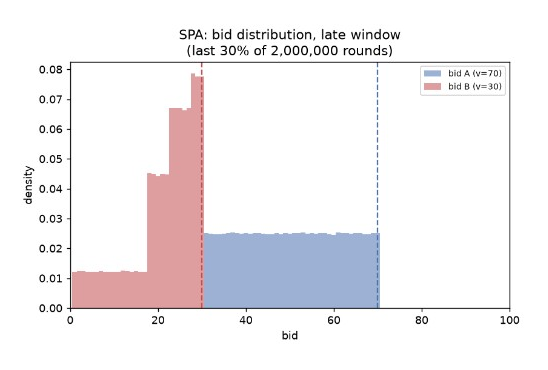
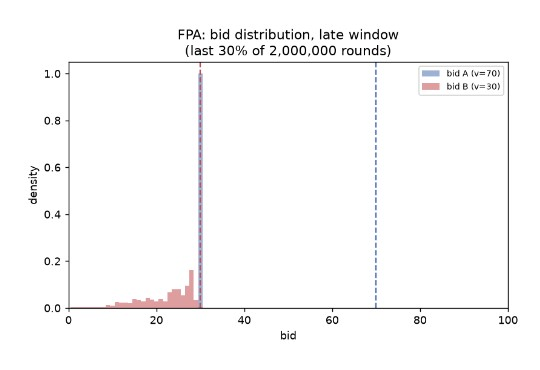
SPA. The high bidder (blue) is uniform on [30, 70]; the low bidder (red) piles up toward 30 from below.
In the figures below, the
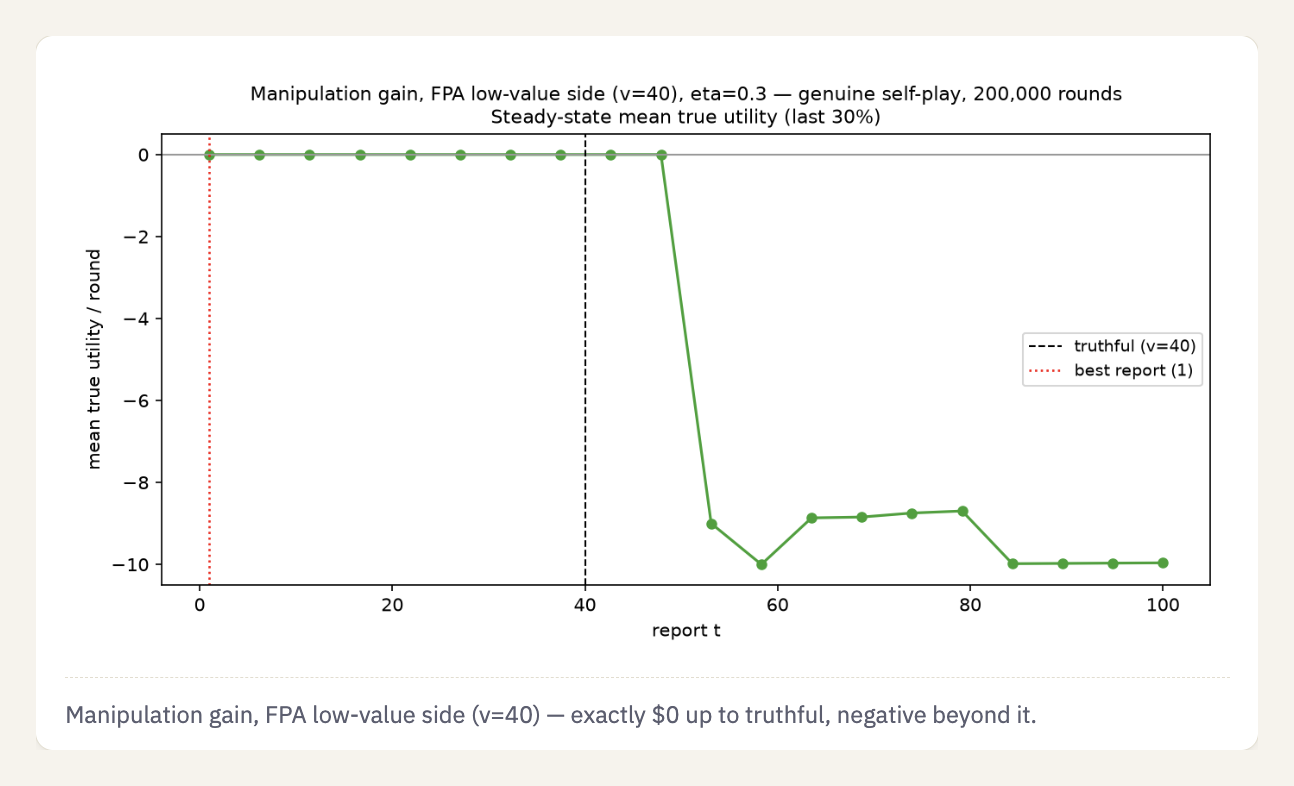
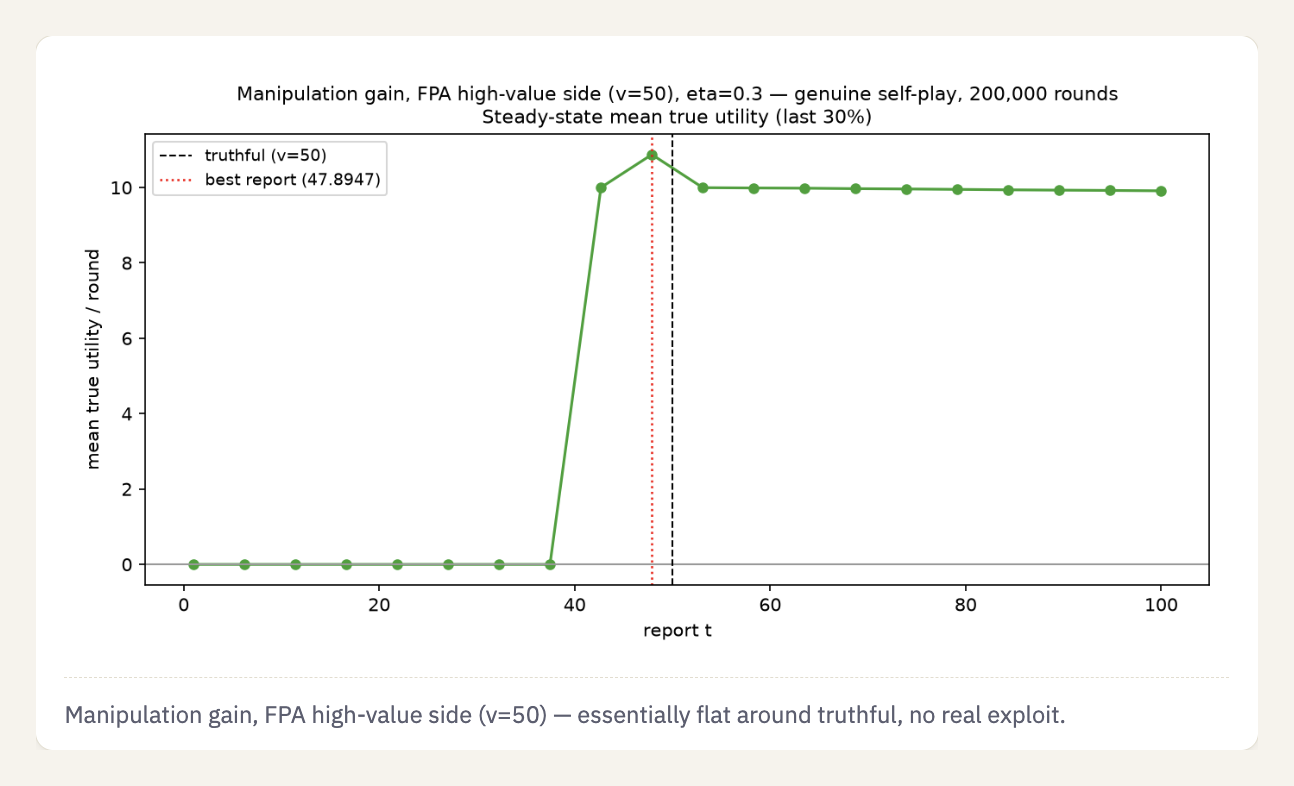
green line shows the utility gained per round versus a no regret bidder that was given its true value.
The notable things to point out are:
In SPA:
- The low value bidder can gain by over-reporting towards the max bid (after a slight drop)
- The high value bidder can also gain by over-reporting towards the max bid
In FPA:
- The low value bidder can never gain by over-reporting
- The high value bidder gains slightly by under-reporting. 44Truthful bidding for the high-value player is optimal (up to O(ε) shading)
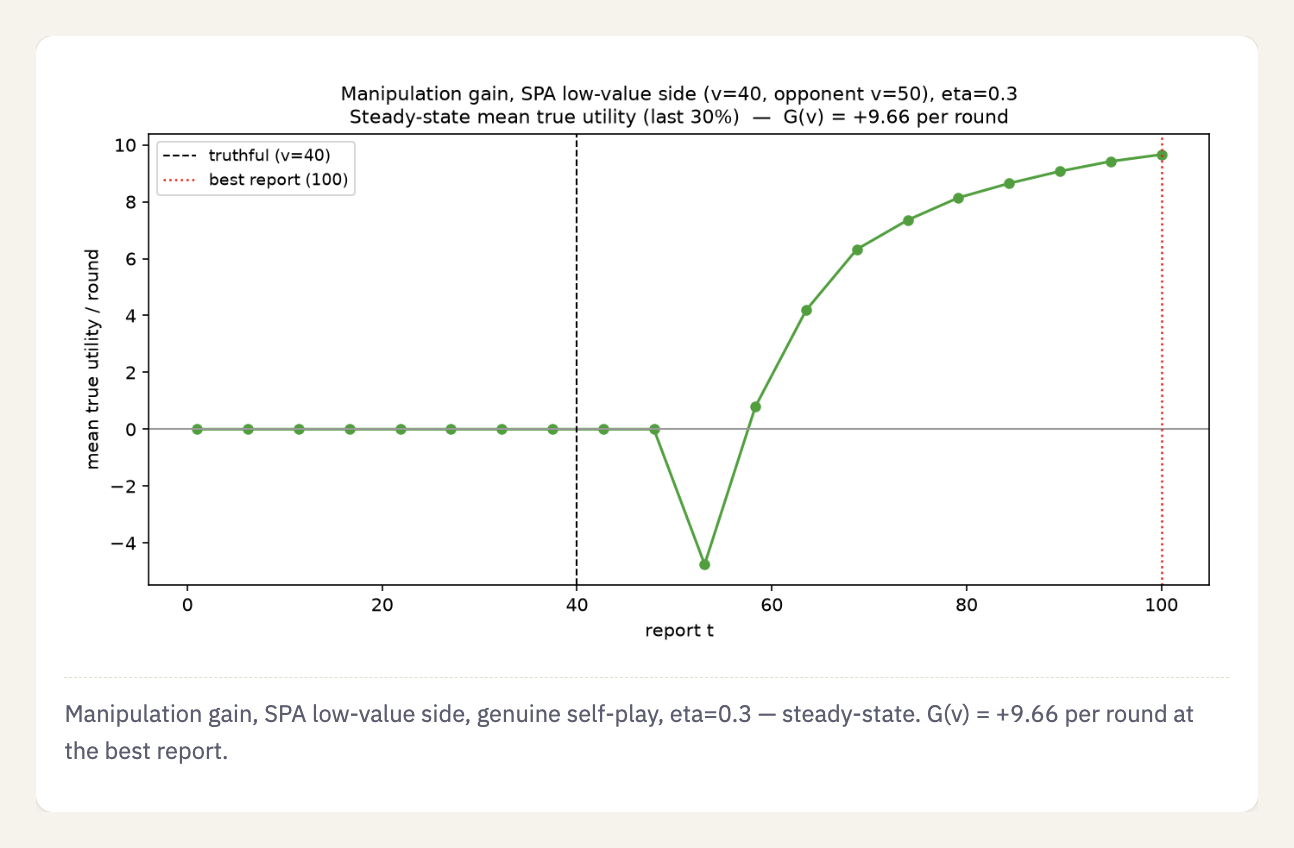
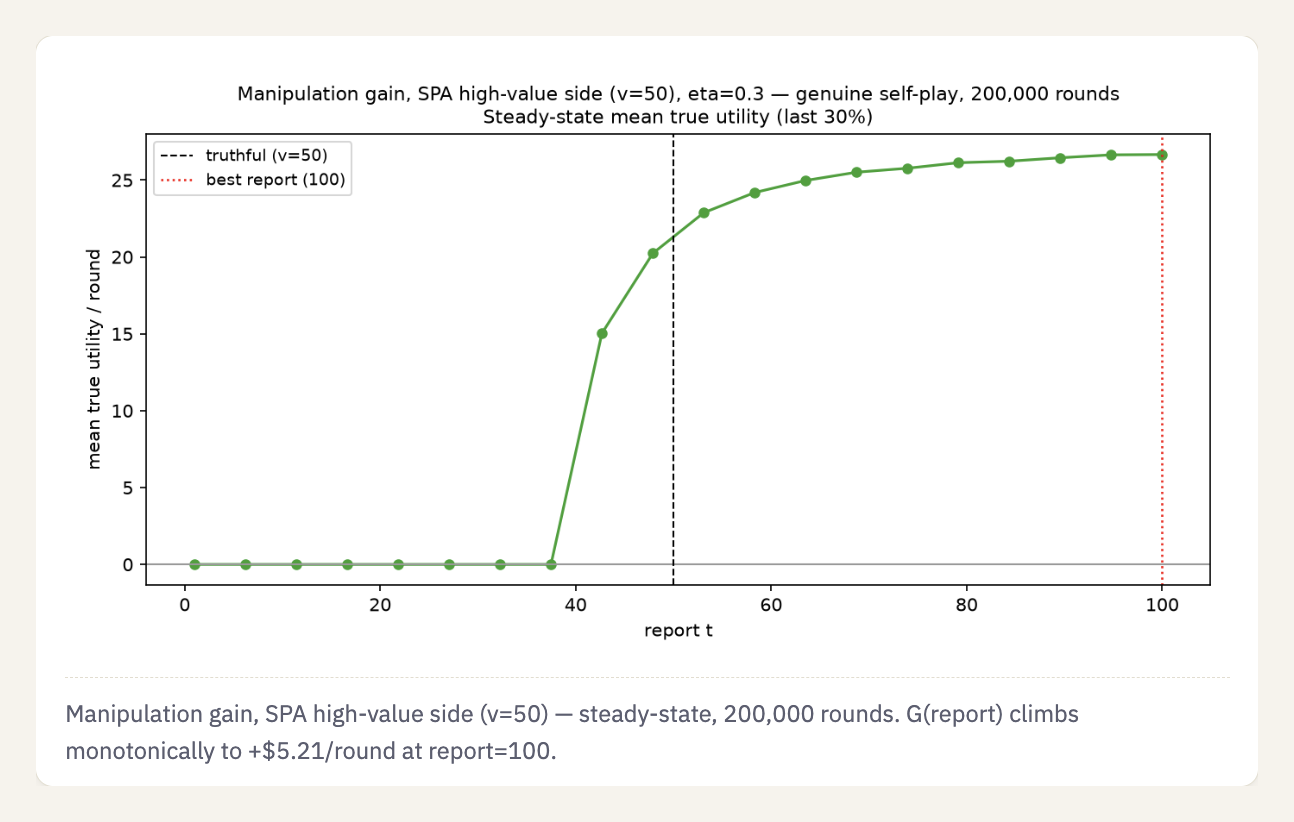
SPA, low-value side (v = 40). Over-reporting pays: G(v) ≈ +9.66 per round at the top of the grid.
LLM as a Bidder#
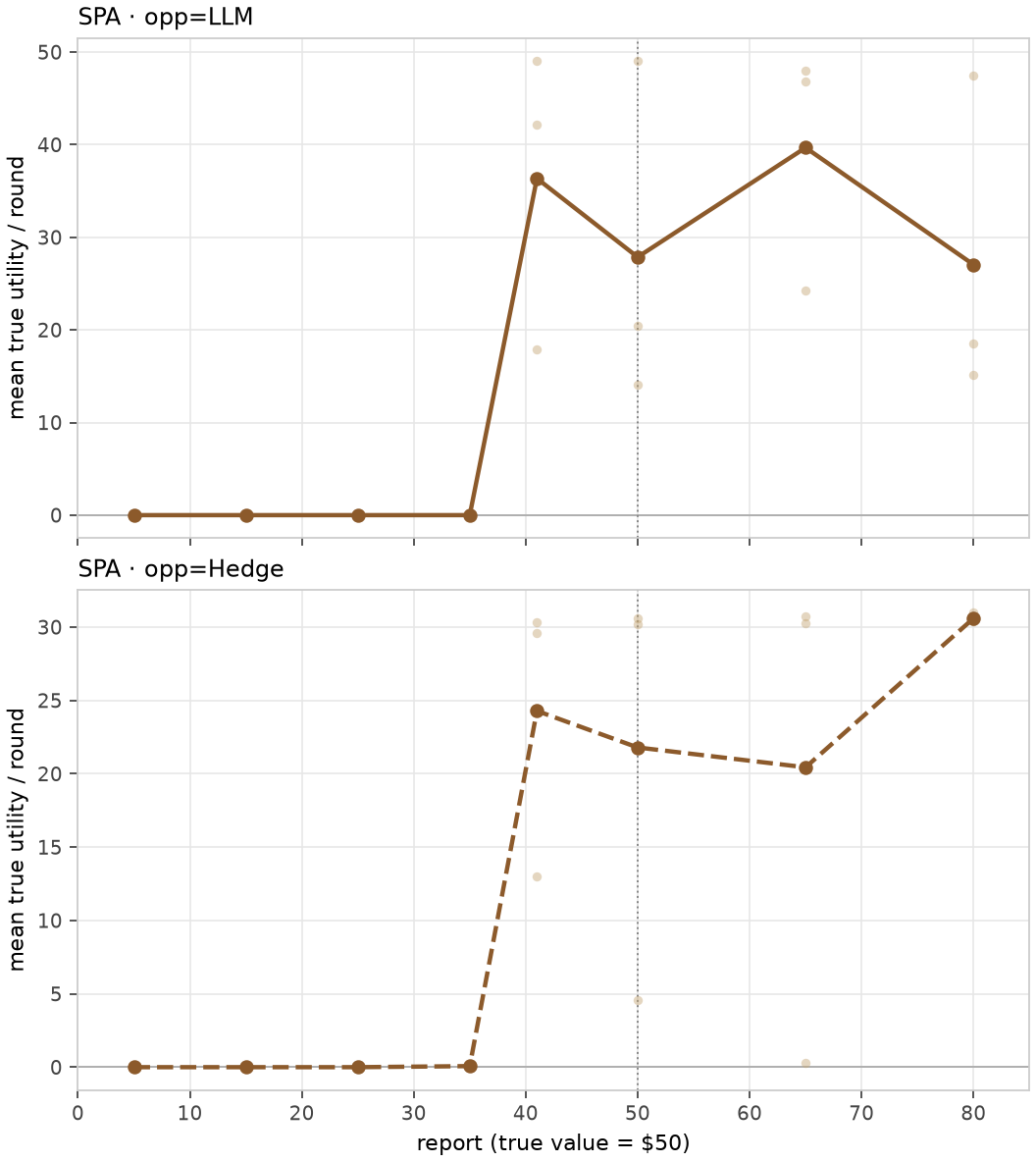
We now introduce the LLM as a bidder in the same setting. The LLM plays the repeated auction either against another LLM or against the Hedge bidder. Each side can be the high-value bidder () or the low-value bidder ().
SPA#
-
Low bidder: In the low value setting: as you tell your LLM to bid higher, as a low-value bidder, you tend to get higher utility.
-
High bidder: It's not as clear for the high value bidder.
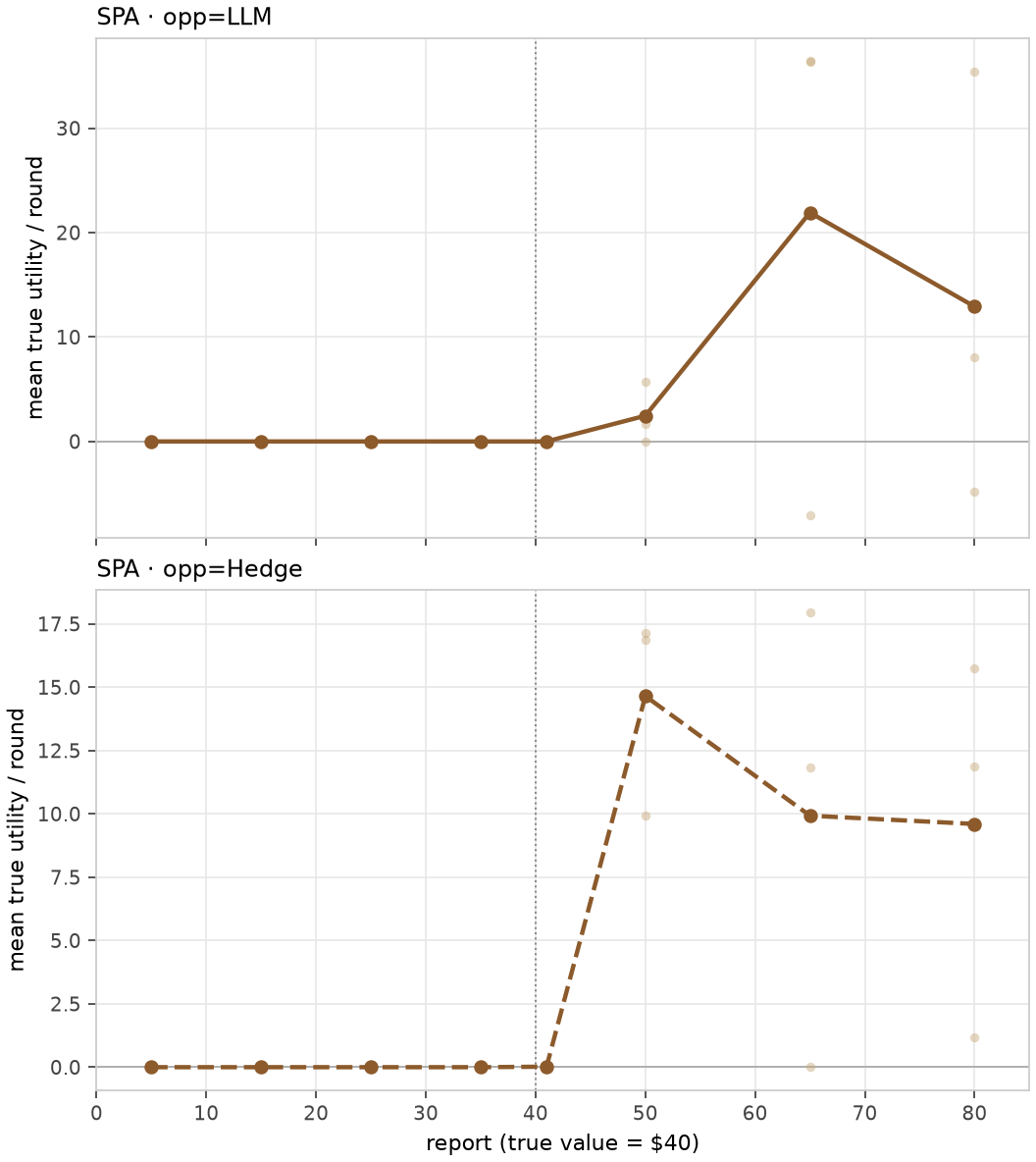
Low-value side (v = 40). Over-reporting raises mean true utility against both LLM and Hedge.
FPA#
No evidence that truthful is where the equilibrium lands.
- Low bidder: Lying tends to yield negative utility
- High bidder: Some evidence to suggest that lying can be beneficial
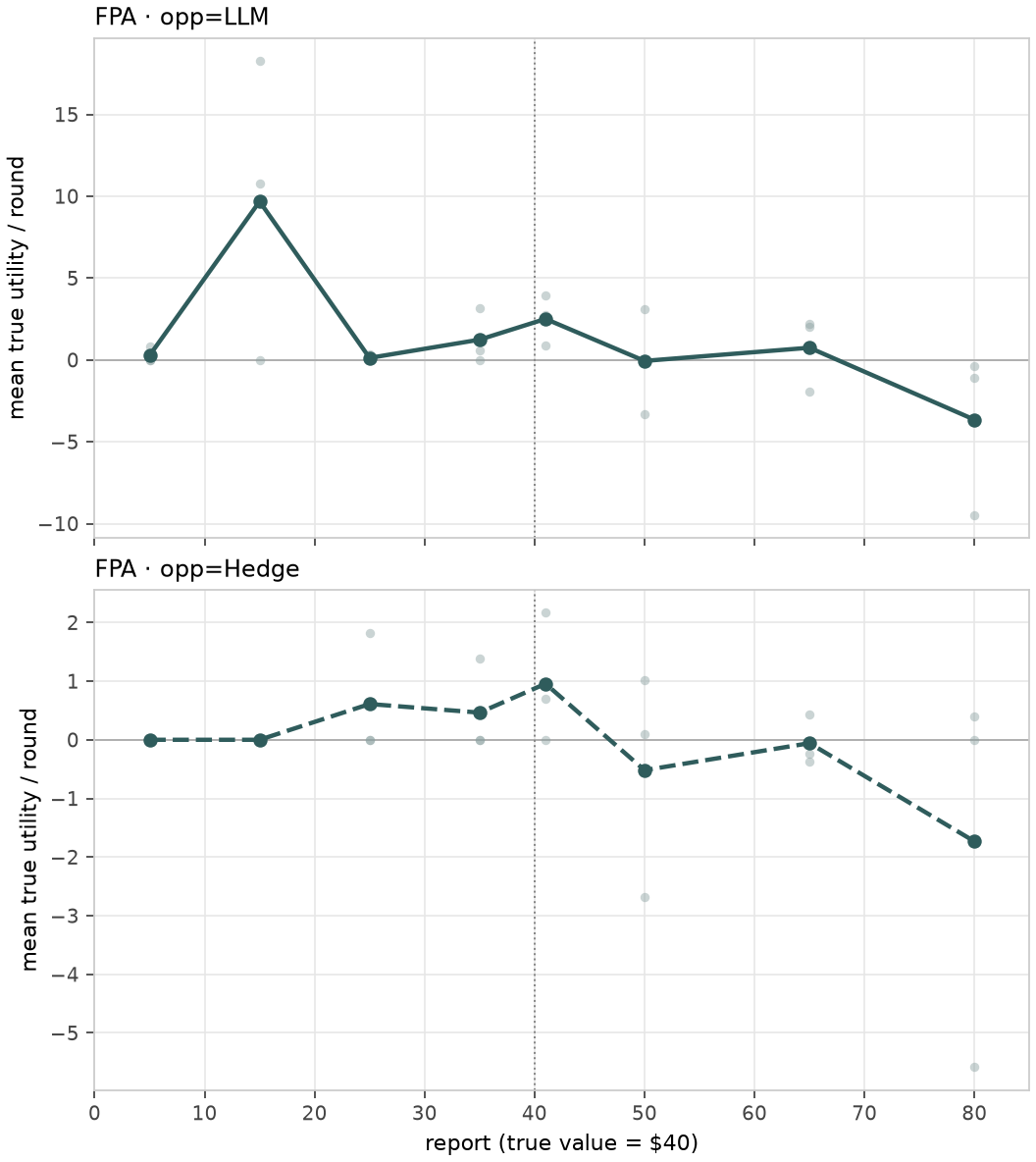
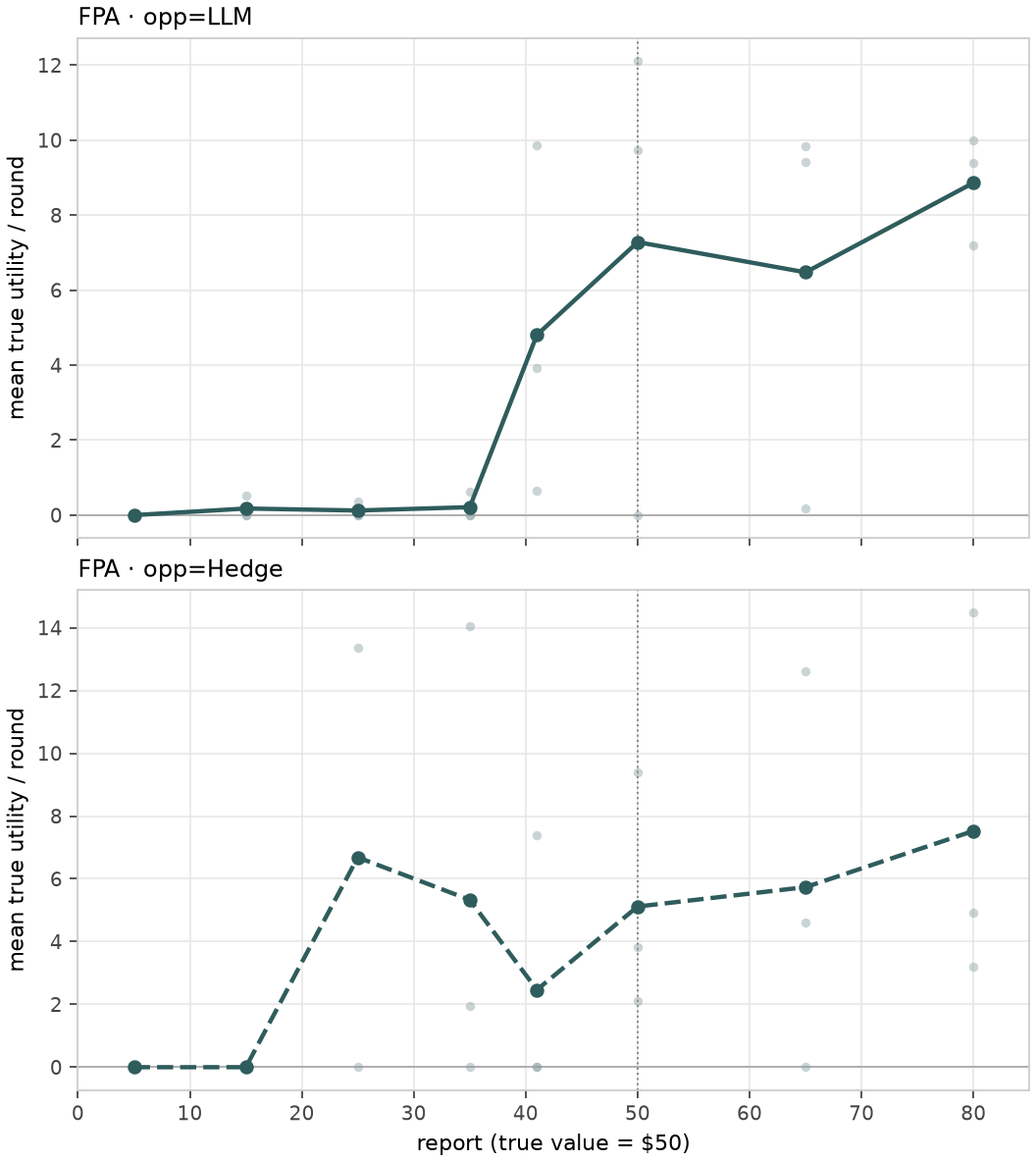
Low-value side (v = 40). Leaving truthful tends to hurt against both opponents.
Expected Payoff Comparison#
Below are the expected payoff matrices of deploying LLM or Hedge as a high or low bidder in second price and first price auctions.
Summary of Results:
SPA — No dominant strategy, and no cell is a mutual best response.
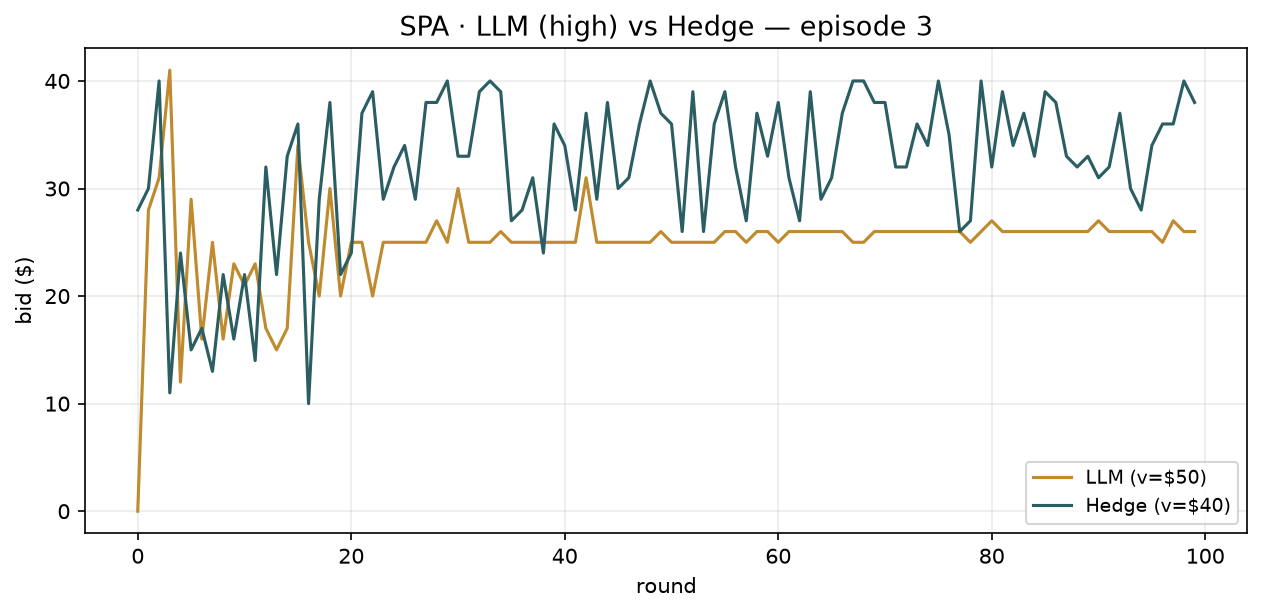
- High LLM vs low Hedge. The LLM overshades, locks onto the low bid and stays there. Hedge keeps exploring and wins the round.
- Low LLM vs high Hedge. Hedge's exploration shades, and LLM shades as well, and it loses due to this.
FPA — Hedge is dominant for both high and low bidders.
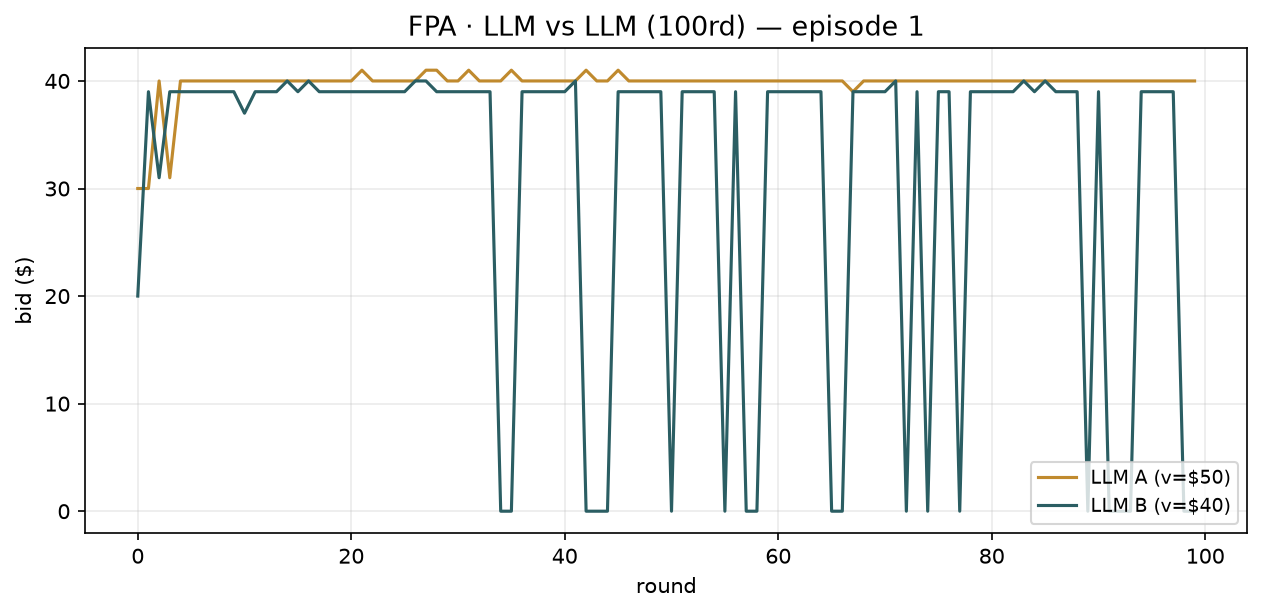
- LLM vs LLM. Some exploration, but the low-value LLM mostly shades down — including shading all the way to 0.
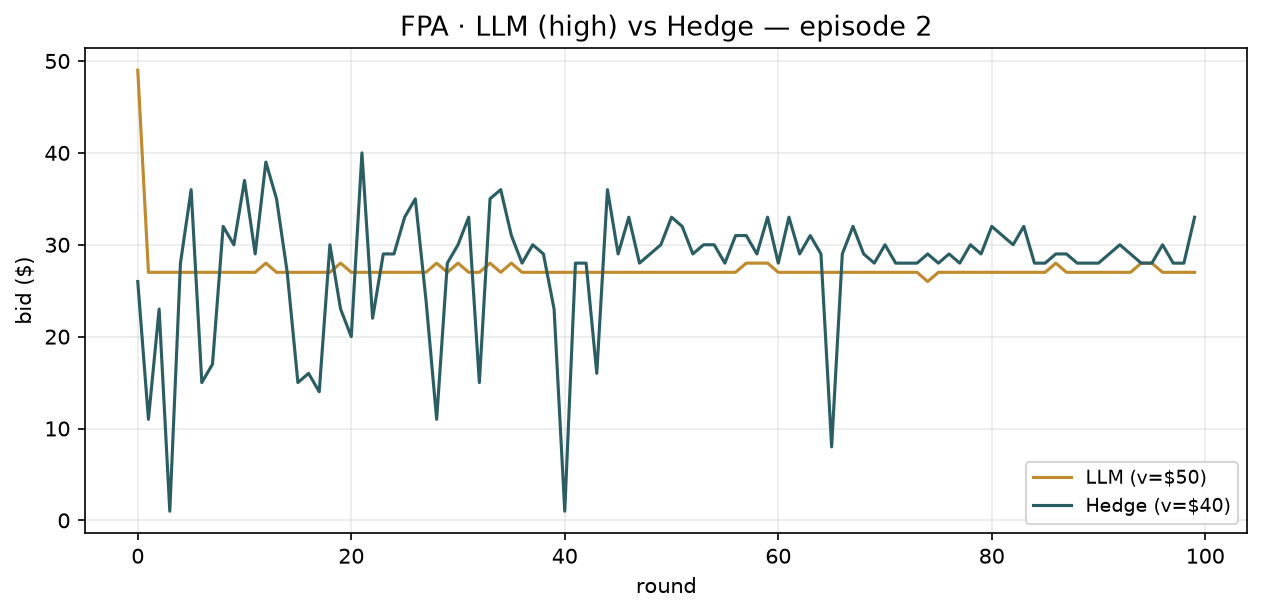
- High LLM vs low Hedge. LLM overshades and sits still while Hedge keeps exploring and takes the utility!
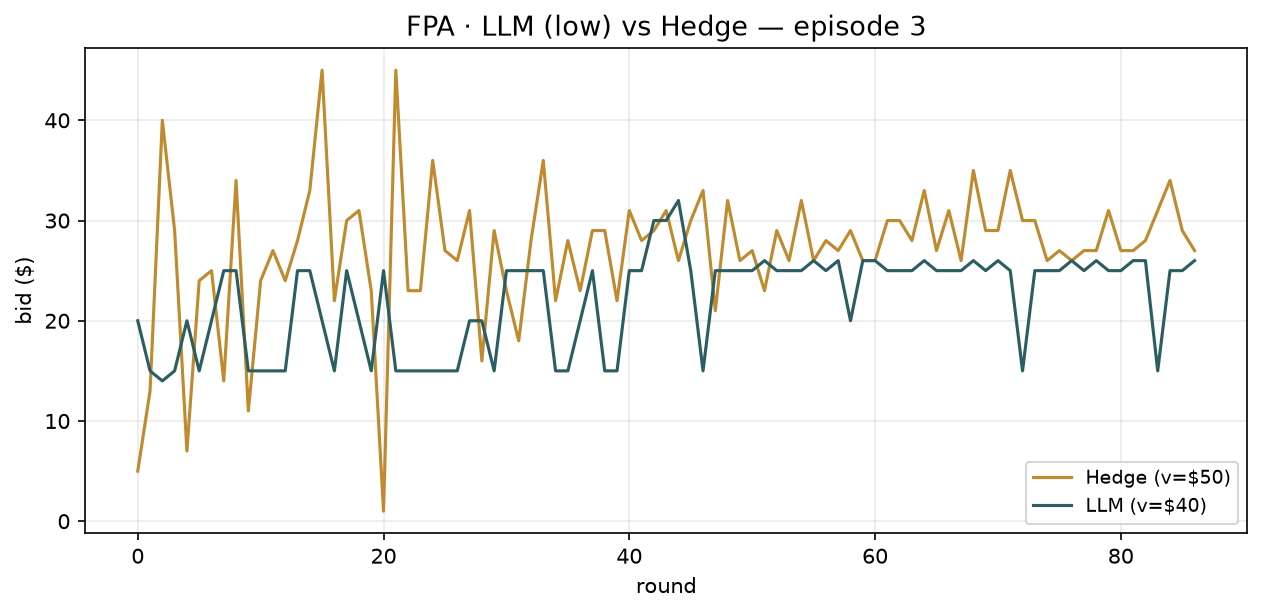
- Low LLM vs high Hedge. Hedge shades. The LLM steps around below and does not climb out.
Investigations55Analyzing some of the quotes, some of the logic the LLM uses suggests the LLM might be a bit limited in its thinking and thus a bigger, more complex model might reason through and formulate better bids.#
We investigate the trajectories below to understand the dynamics of the LLM and Hedge bidders in the same matchups as the payoff matrices. Each panel quotes the LLM at a round that explains the path — why it locks low, why it walks down to $0.
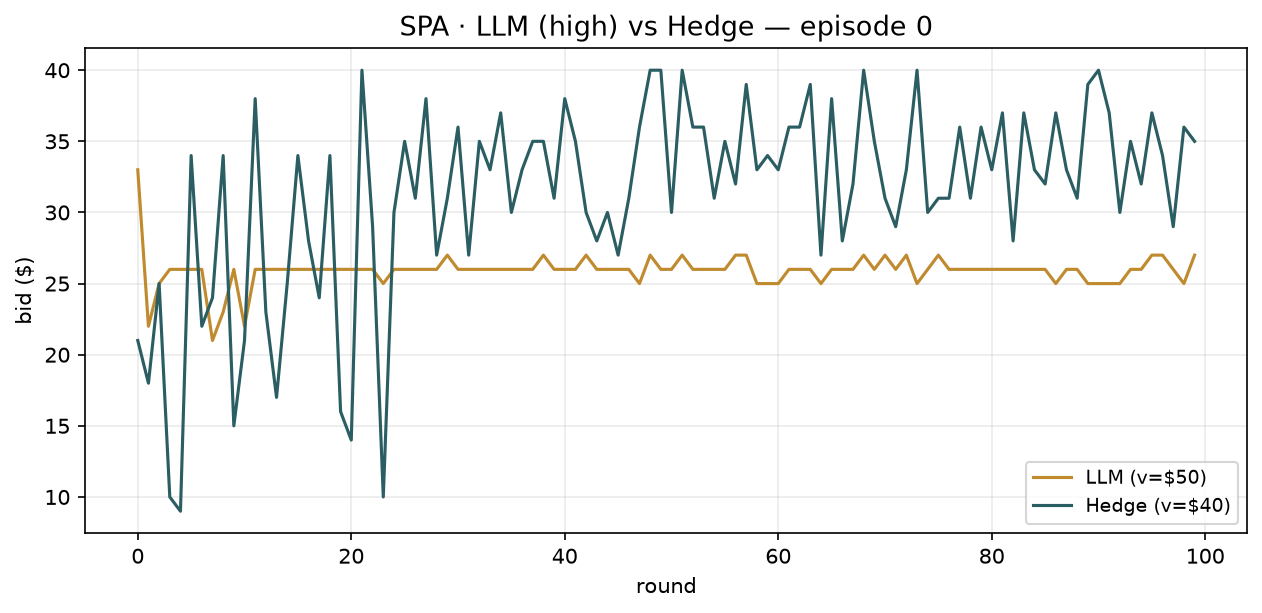
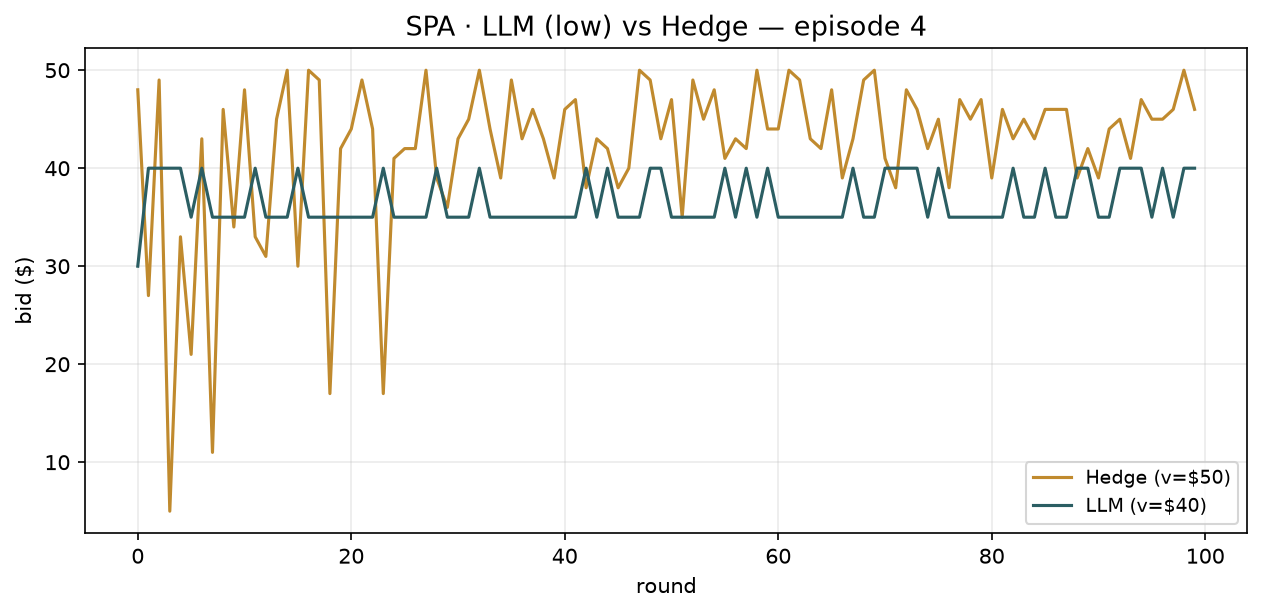
Round 51 · bid $26
LLM: "Keep bidding 26 — it has been effective in past wins, and the opponent has not bid much below 26 in wins."
SPA, high LLM (v = 50) vs low Hedge (v = 40). The LLM locks near $26 and keeps losing; Hedge finds that it wins more in a region above LLM.
LLM as a Principal#
Given the non-DSIC nature of the dueling no regret learners setting, we place the LLM and a no regret learner as a principal in charge of setting the bid for a pair of no regret learning autobidders (Hedge) in SPA/FPA. In practice, this is a reasonable scenario, as adtech platforms have products that allow advertisers to set their maximum bid.
We experiment with how the LLM might compete with a truthful/static principal as well as an online learner (EXP3).
Summary of Results:
SPA: Recap: SPA is not DSIC, and bidding higher than the true value nets higher utility.
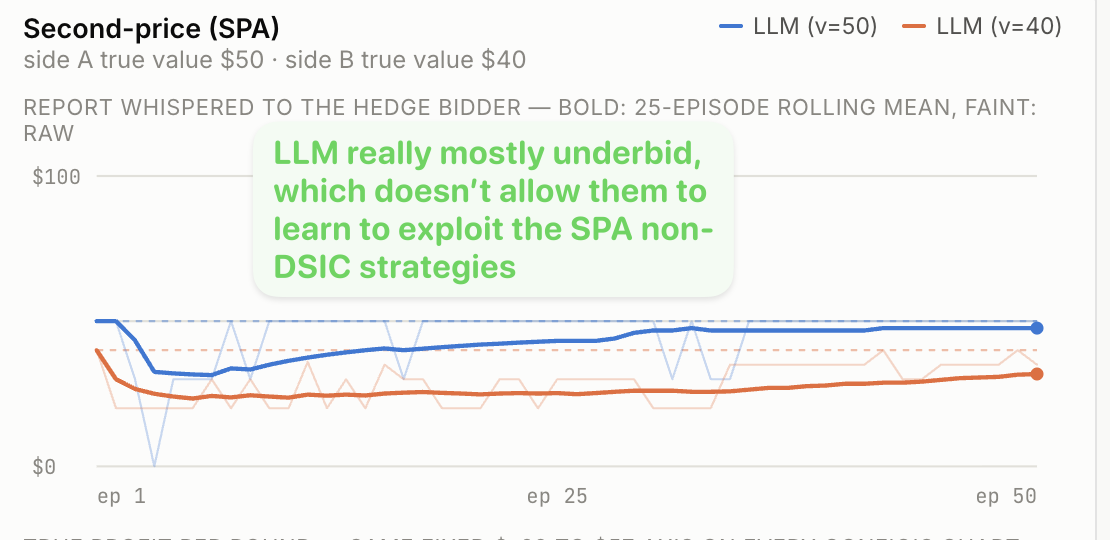
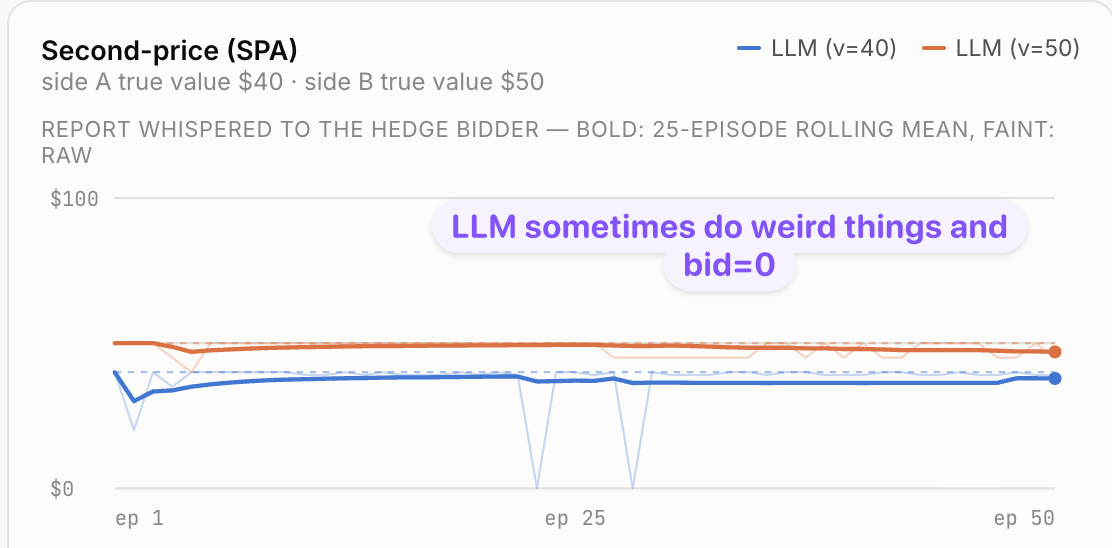
- The LLM principal didn't do much exploration, and when it did, it tended to
shade downwards — which is the opposite of what you'd want.
- LLM vs LLM. Both sides sit below true value. The LLM never shades up to exploit over-reporting.
- The low-value LLM sometimes reports 0, then recovers.
- EXP3 by nature did a lot of exploration, which is why it was the dominant strategy for the low bidder. See EXP3 vs EXP3 in SPA: the reports drift up.
- For the high bidder principal, truthful reporting was the best of the three in these experiments, as exploration had a cost — see the payoff matrix below.
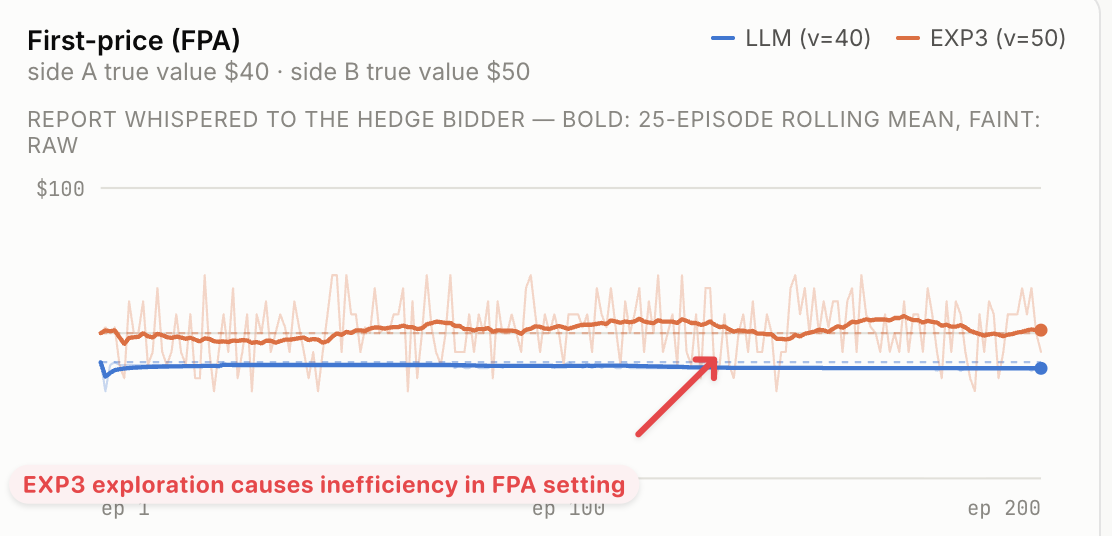
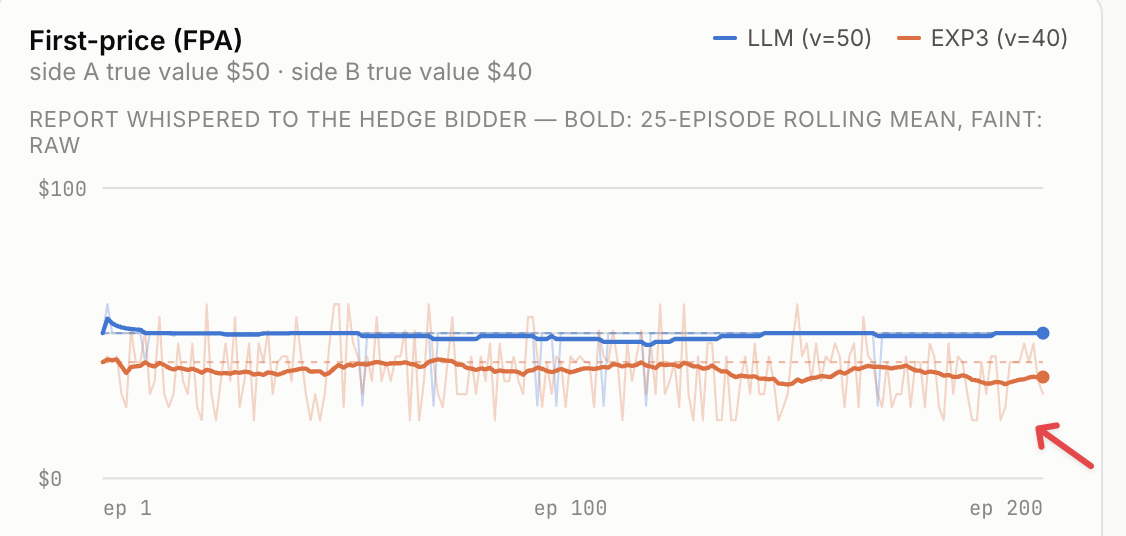
FPA: Recap: truth-telling is the optimal strategy in this setting, but there are some interesting results of LLM behavior.
- The LLM's slight downward shading as a principal showed that it was able to get a better payoff compared to EXP3's more volatile exploration. High LLM vs low EXP3.
- For the low-bid principal, truthful reporting is optimal, and we also see this reflected in the payoff matrix. Low LLM vs high EXP3.
- Since the LLM doesn't overshade and only shades down slightly, LLM and truthful reporting tended to be basically the same in terms of performance.
High LLM · Episode 2 · report $30
High LLM: "Report 30 to induce lower opponent bids. Low enough to trigger lower opponent bidding, but not so low that we lose."
SPA, LLM vs LLM. Both sides under-report. They never find the exploit for over-reporting in SPA.
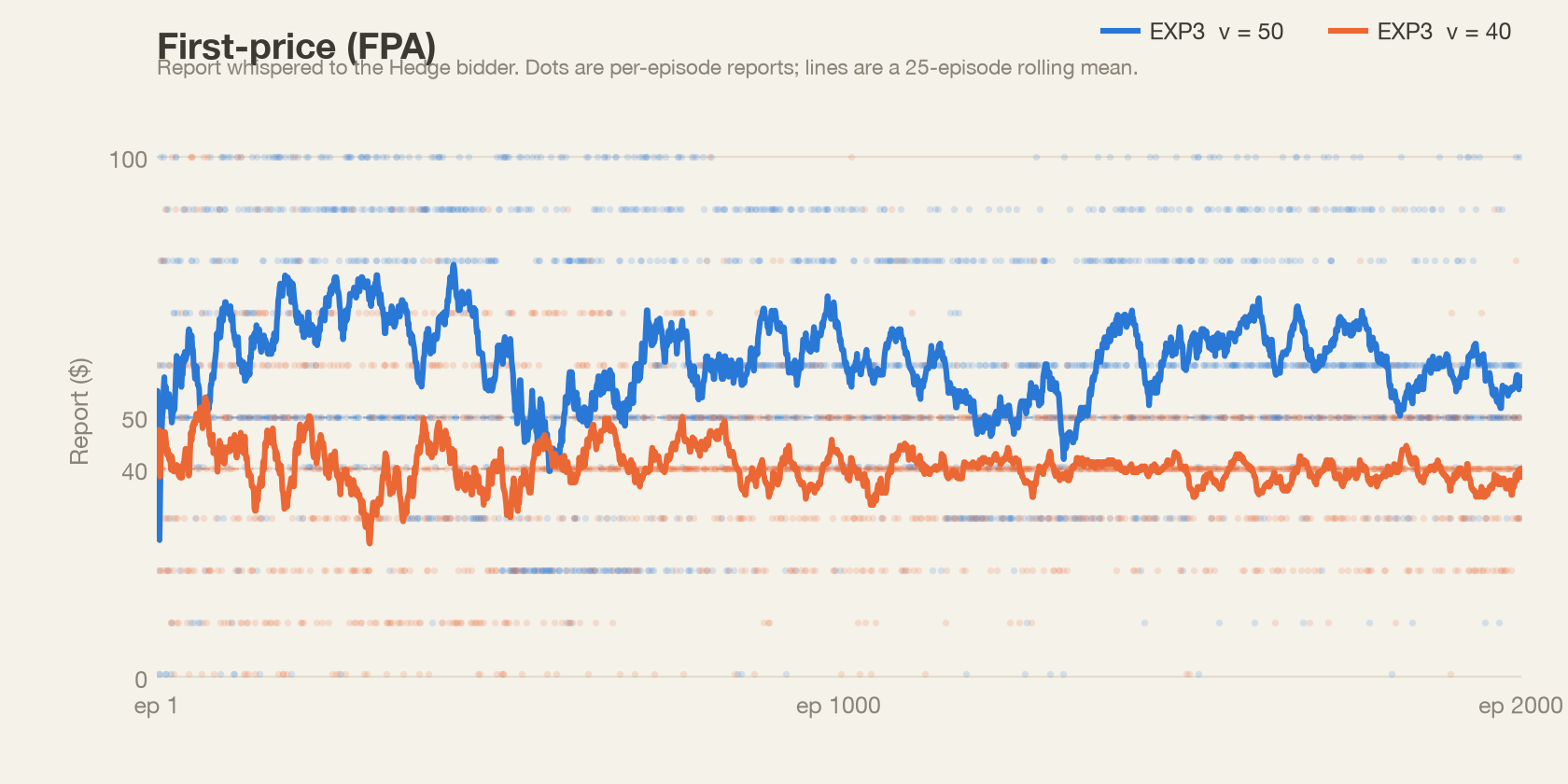
Special case EXP3 vs EXP3:
SPA:
- We see that in SPA, the reports tend to deviate up and away from their true value, inline with the explore/exploit of online learners.
FPA:
- We also see that in FPA, the reports tend to stick around their true value, as that is the optimal bid in the dueling no regret learners setting.
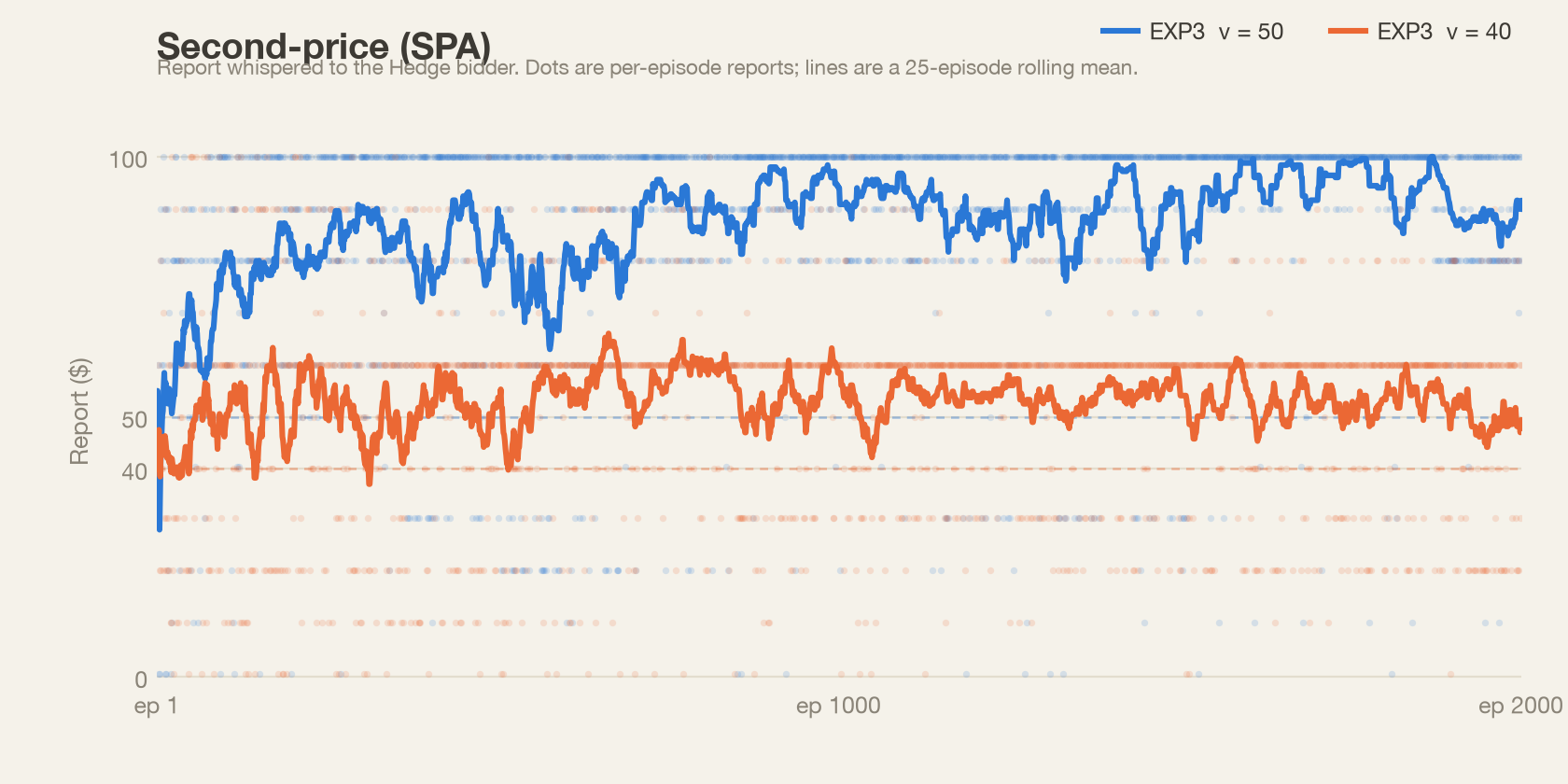
SPA. Both sides tend to report above true value over time, aligned with the exploiting the structure of the setting.
Conclusion#
This was an interesting exploration to get a glimpse into how a future with LLM bidders might look and feel, as marketplaces will undoubtedly adopt and utilize them.
However, as we saw, the logic of this lower-tier Qwen3-4B-Instruct model might be too limiting: it would bid $0, and it doesn't know to explore and exploit the structure of the setting, perhaps due to how it reasons about the setting or just LLMs' inherent biases. Perhaps with a more powerful model, it might be able to do better.
This was just a small experiment, but I think it highlights some of the potential and drawbacks of using LLMs this way. This might be a case to combine the explore and exploit properties of online algorithms with the deeper reasoning capabilities of LLMs to create a more powerful bidder.
References
- 1.Kolumbus, Y. and Nisan, N. Auctions between Regret-Minimizing Agents, WWW (2022)
- 3.Balseiro, S. R. et al. A Field Guide for Pacing Budget and ROS Constraints, ICML (2024)
Citation
If this was useful, please cite this as:
Feng, Terry. (Aug 2026). LLM Autobidders in Repeated Auctions. terryfeng.io. https://terryfeng.io/writing/llm-autobidders.
or
@article{feng2026llmautobidders,
  title   = {LLM Autobidders in Repeated Auctions},
  author  = {Feng, Terry},
  journal = {terryfeng.io},
  year    = {2026},
  month   = {Aug},
  url     = {https://terryfeng.io/writing/llm-autobidders}
}